
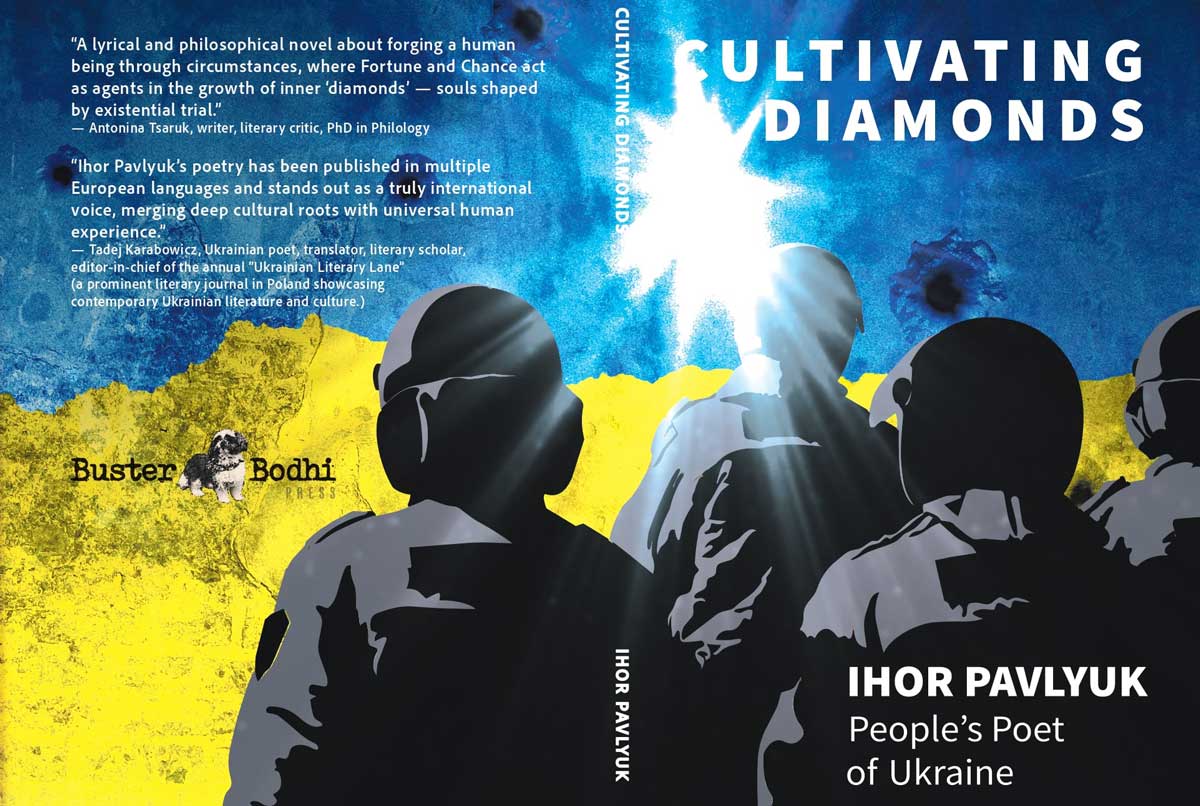
Pavlyuk Ihor. Cultivating diamods: Novel and poems.
USA: Buster Bodhi Press, LLC, 2026. – 198 p.
Щойно у Сполучених Штатах Америки під патронатом Національної федерації державних поетичних суспільств США (NFSPS) окремою книгою опубліковано переклад роману Ігоря Павлюка «Вирощування алмазів» англійською мовою, яку вже можна придбати на платформі Amazon
В анотації книги «Cultivating diamods» зокрема зазначено:
«Ігор Павлюк, народний поет України, представляє міжнародній літературній спільноті філософський роман, який гостро й переконливо осмислює наш час. Це не просто художній твір, а автентичний голос, що вибудовує складний сучасний світ, де поруч із солдатами й поетами діють ангели – Доля, Випадок, Простір і Час. Buster Bodhi Press» і відкриває читачам усього світу можливість зустрітися з авторською свободою поєднання унікальних людських характерів, фізичних і філософських вимірів, гумору, історичної глибини та життєвої мудрості».
* * *
Частина виручених від продажу книги коштів піде на допомогу українським дітям-сиротам.
I. Metaphysical Architecture: Genius Under Pressure
In Cultivation of Diamonds, Ihor Pavlyuk builds a layered narrative that moves across a Soviet military school, Leningrad’s cultural landscape, prehistoric shores, medieval execution grounds, and a cosmic research center where Time, Space, Chance, and Fate observe humanity as if it were a laboratory species. These planes are unified by a single question: what energy sustains humanity — and at what moral cost?
At the center stands the recurring genetic marker “24-X-315,” a figure reincarnating across epochs as soldier, poet, artist, lover, and victim. Pavlyuk presents genius not as individual triumph but as compressed energy — a “diamond” formed through pressure, deprivation, and spiritual discomfort. Art does not redeem the world; it enables the survival of the hyper-sensitive few whose suffering paradoxically preserves the species.
The chilling “Loa’s Diary” sharpens this vision, suggesting that from a cosmic perspective moral categories dissolve into energetic calculations. Genocide, altruism, extinction, and brilliance become variables in a vast equation. The novel does not justify this logic — it exposes its terrifying coherence.

II. War, Witness, and Moral Vision
The book’s poetic core is structural, not decorative. In “The Blind,” the poet appears as a paradoxical seer — physically disarmed yet morally luminous. Vision, Pavlyuk suggests, is ethical rather than optical; faith persists not as comfort but as resistance.
The war cycle, especially “Spring and War” and “Nowadays,” abandons metaphorical safety. Fighter jets replace birds; sirens thread through civilian consciousness; blood donation and restraint become the last gestures of agency. War is not framed as tragic destiny but as systemic collapse — a circuit consuming both victim and executioner. Pavlyuk stands within the Eastern European tradition of witness poetry, yet refuses sentimental heroization.
In “To My Brother,” historical betrayal becomes intimate. The offering of “water and bread” carries biblical resonance while functioning as political accusation. Forgiveness appears without reconciliation, hospitality without moral amnesia. Memory here is both wound and obligation.
III. Love, Fragility, and the Energy of Creation
Perhaps the most distilled philosophical statement appears in “Immortality of Water,” where elements outlive ideology and resurrection belongs not to humans but to matter itself. Water, light, and temperature endure; humanity is rendered “human-glass” — capable of brilliance yet fated to shatter.
What prevents the work from collapsing into nihilism is its insistence on love as creative force. In one of its most haunting images, a prehistoric artist paints his beloved on wet sand, choosing creation over possession. The waves erase the image, but the released energy — the act of love itself — remains indestructible.
Cultivation of Diamonds demands a reader willing to inhabit contradiction: art as salvation and curse, genius as gift and evolutionary instrument, humanity as miracle and error. It offers no consolation, but it provides something rarer — a language proportionate to the scale of contemporary moral confusion.
Petro Fisher